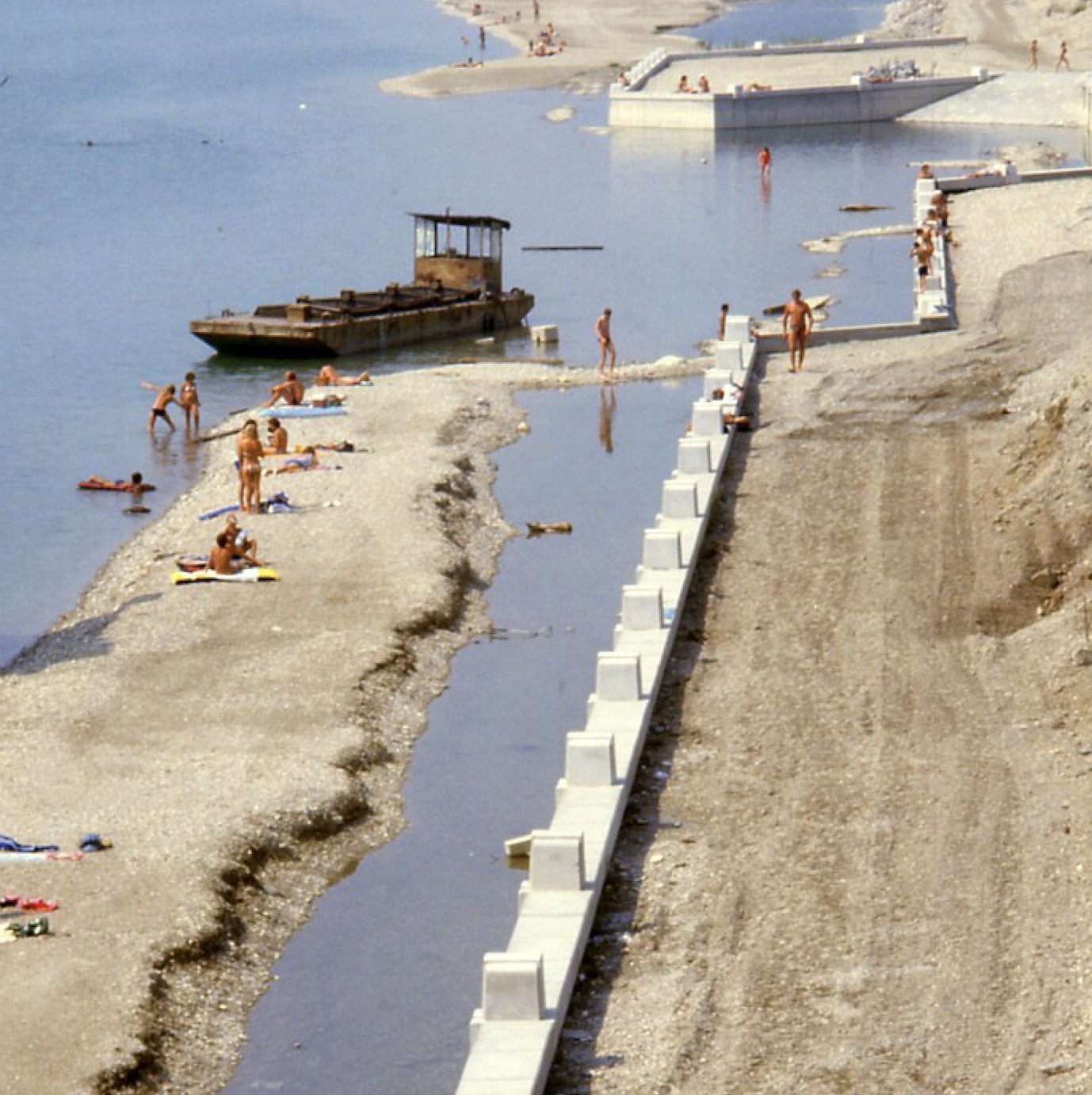
Construction of Donauinsel, Vienna, 20 July 1983
Photograph: © 1ARs631, via Wikimedia Commons (attribution-only licence).
What counts as critical infrastructure? Who should design, own, govern, maintain and care for it? And what is happening as many are brought back into making more tangible, vulnerable, personal relationships with land and water, fire and flooding, and other decidedly ambivalent beings and forces on which life, in any of its forms depends? What is happening out there on the ground, or in the mud, if you will?
The term infrastructure is very young. But infrastructure as the architecture of the beneath and in-between is as old as the hills: repeating patterns of practice, use and relationship-making between houses and settlements, people, land, water and the beyond human, which often thicken into, or are thickened by, material form. Modern infrastructure, from energy grids, roads, dams, canals, mines and factories, housing, property, data networks and storage, emerged as the scaffolding of extractive and settler colonialism, industrialisation, militarisation and statecraft. Dominant infrastructure domesticates peoples, lands, waters and their inhabitants into labour and resources for accumulation. Its enchantment and authority rest on increasingly precarious promises to mediate our relationships with water, fire, storms, waste, ‘energy’, ‘enemies’ and food through distant systems, techniques and specialists. It promises mobility, security, comfort, convenience and abundance for some, while keeping the dispossession, toxification, exploitation and immobilisation of others at a distance.
Over roughly the past twenty years, state definitions and typologies of critical infrastructure, or the recurrent forms through which it is materially, spatially and institutionally organised, have expanded to encompass infrastructure’s own infra: wetlands and mangroves as flood and storm protection; rivers as feeders of dams and generators; forests and wetlands as carbon stores, water regulators and soil stabilisers; ‘nature-based’ flood and fire prevention; community movements and cultural practices as means of regenerating land and water, securing territories and producing value; Indigenous knowledge and ceremony. Yet a crisis of abstraction deepens. Designating relations bracketed as ‘Nature’ or ‘culture’ as infrastructure can narrowly recodify and reterritorialise them, subjecting them to optimisation through metrics, asset valuations, algorithms and risk calculations. But intensifying floods, droughts, fires, pandemics, wars, refusals and protests exceed and reshape techniques of securitisation. As more relations are absorbed into the category of infrastructure, responsibility for their care is increasingly redistributed outwards. What else, then, is critical, and for whom?
Dominant infrastructural regimes thus appear to be making riskier moves. Authority, jurisdiction, ownership and the capacity to design essential forms of relation are being devolved, redistributed, reclaimed or reasserted. We use the term archipelagos to allude to the discontinuous zones in which people reclaim, are authorised — or forced — to enter into much more direct relationships with the capricious forces on which they depend. Plural or hybrid forms of infrastructuring are of course nothing new, modernity multiplied such hybrids even as it worked to separate and obscure them. What may be historically pivotal amid crisis is that dominant regimes themselves increasingly carve out, concede, recognise or abandon such zones, bringing longstanding practices irreducible to economic, state or scientific rationalities into newly consequential relations with law, engineering, technology and finance, sometimes through larger extrastate federations allied around the protection of their ways of life. The question, therefore, is not the existence of difference itself, but who gets to make these relationships and how: a question of politics and design par excellence.
But an apparent islanding of authority and jurisdiction is double-edged. Capitalism has of course long pushed the foundational work of care, reproduction and ‘defence’ onto ‘volunteers’, enthusiastic or not: into kitchens and bedrooms; onto women and their drafted sons, dispossessed communities and classes, bacteria, birds, forests and rivers — those compelled to adapt to the relentless rhythms of production, whose care and protection are unreciprocated and whose work is unremunerated. Resituating responsibility may redistribute meaningful authority, or simply redistribute labour, exposure and risk. Nor are devolution, recognition, restitution and reappropriation equivalent: Indigenous jurisdictions, for example, often predate the state and cannot simply be reduced to something it grants. Are states permitting or recognising forms of authority they cannot fully assimilate, or are these the emperor’s new clothes: familiar abandonment and responsibilisation recast as autonomy and plural governance?
Put concretely: who may burn, flood, irrigate, maintain, repair, harvest or refuse; what lives and ways of life are protected, enabled to reproduce, exposed, sacrificed or left to die; according to whose law, knowledge and authority; and who gains or loses? Can vulnerability and our exposure to and dependence upon relations and forces that cannot be fully mastered become more immediate, visible and collectively negotiated without erasing radically unequal distributions of exposure, labour, authority and protection? Might emerging ‘experimental zones’ of infrastructuring produce ontologically plural archipelagos — simultaneously modern and beyond, connected yet divergent — in which different forms of reason, practice, knowledge and architecture coexist without collapsing into one universal infrastructural order? Might this amount to infrastructuring otherwise, or do such differences ultimately become new techniques through which dominant infrastructure reproduces itself? What are the consequences for expert divisions of labour and knowledge, and for professions in design, architecture, the humanities and government that emerged alongside infrastructural abstraction?
SUBMISSIONS
We welcome original, unpublished contributions from academics, researchers, designers, practitioners and others studying, practising, governing, contesting or transforming infrastructure. We particularly welcome work from architecture, landscape and urban design, engineering, anthropology, geography, political ecology, STS, planning, law, history and policy. The symposium will also include invited contributions from community and Indigenous practitioners, land and water protectors, activists, cooperative and commons organisers, municipal actors and others working directly within the situations under discussion.
We are particularly interested in situations on the ground in which dominant forms of infrastructure are being contested, appropriated, hybridised, maintained, repaired or transformed, and in places where different forms of authority, knowledge and practice meet: where law, engineering, technology and finance encounter customary or Indigenous law, situated knowledge, ceremony, collective maintenance, ecological care and other ways of organising relations between people, land, water and other beings and forces. Historical and narrative contributions are equally welcome, particularly those which trace genealogies, precedents, suppressed continuities or earlier forms of infrastructuring that illuminate how these contemporary conditions have emerged, and how they might have been otherwise.
We welcome contributions that follow these transformations concretely: who owns, finances, maintains and decides; who performs the work; who acquires meaningful authority; and how conflicts between jurisdictions, scales and forms of knowledge are negotiated or remain unresolved.
Contributions may enter through five porous points of entry: land, water, energy, and data. They could address land return, Indigenous jurisdiction, community energy, collective maintenance, infrastructural refusal and reappropriation, cultural burning, flood or drought management, disaster response, watershed governance, data sovereignty, cooperative ownership, war and reconstruction, or other experiments in the infrastructures that underpin common life.
HOW TO SUBMIT
• Title
• A 400-word abstract
• A short biography (150 words maximum)
• An indication of the proposed presentation format: academic research paper, history and theory paper, practice-based paper, or pedagogical proposition
• Details of any relevant community, institutional, municipal, or field-based collaboration and funding involved
• Indication of thematic strand: land, water, energy, data.
Submission Deadline: 16 December 2026
Notification of Acceptance: January 2027
Please submit your abstract or enquiries to: critical.infrastructure.symposium@tuwien.ac.at
SYMPOSIUM
The symposium will take place 13–15 May 2027, in person at TU Wien, Vienna. Event recordings will be available online. Presentations will be 15-20 minutes, in person.
PUBLICATION
Selected contributions will be part of a single-blind peer-reviewed publication with TU Wien Academic Press.
ORGANISED BY
Research Unit of Spatial Design (Raumgestaltung und Entwerfen), RAUM, TU Wien, and the Institute for Experimental Critical Infrastructure.
CONVENERS
Brendon Carlin, TU Wien; Architectural Association
María Páez González, University College London (UCL)
Wilfried Kuehn, Raumgestaltung und Entwerfen TU Wien