
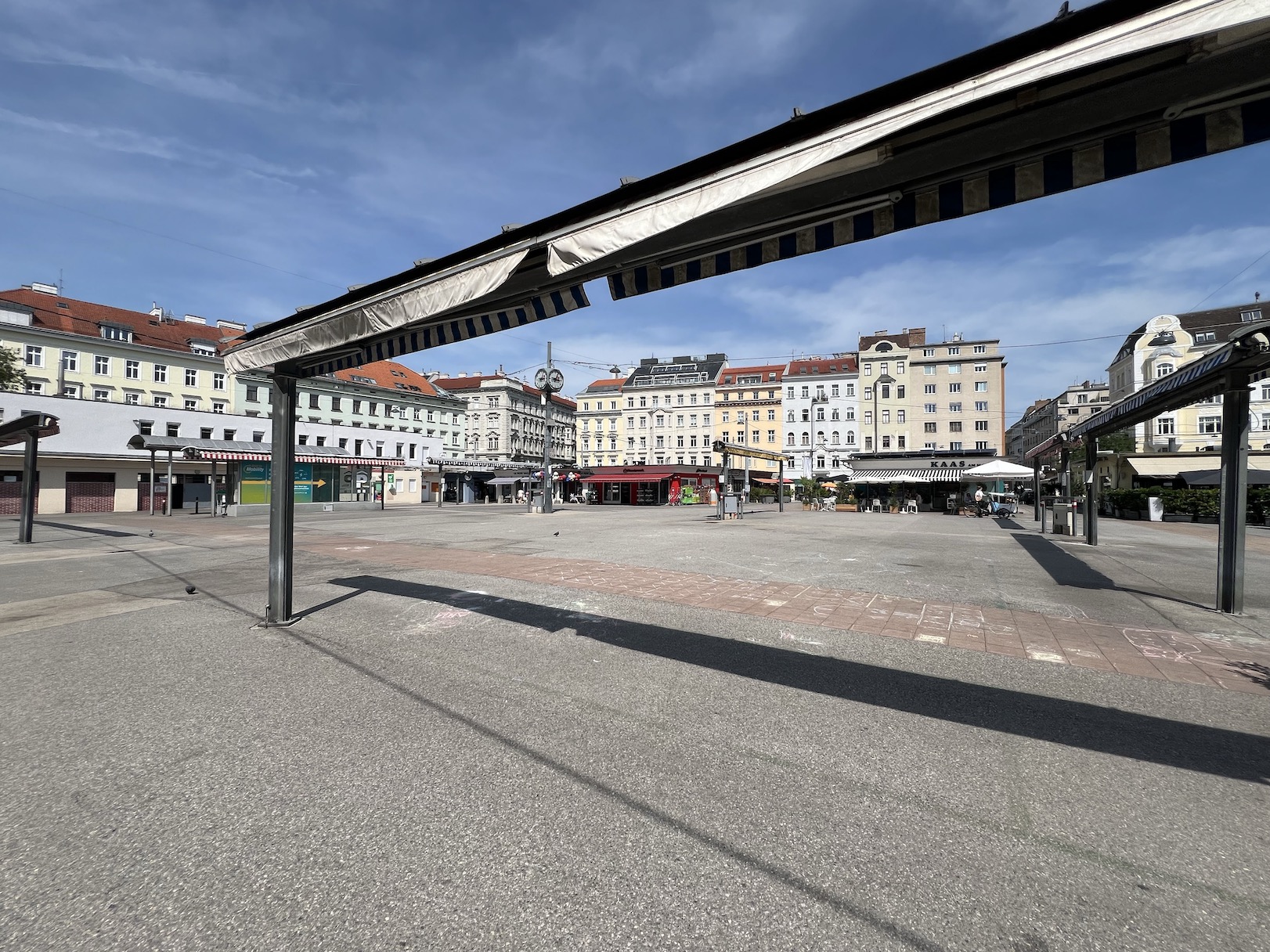
The Karmelitermarkt is one of Vienna’s most historically significant markets and has served as a place for local shopping, social interaction, and urban life for more than 350 years. However, it is currently undergoing profound structural changes that are affecting its spatial, functional, and social performance. The increasing dominance of gastronomic uses, temporary vacancies of permanent market stalls, sealed surfaces, and restricted use during daylight hours are leading to a significant reduction in the quality of the market experience. At the same time, there is a growing demand among the city’s population for regionally produced food, short supply chains, high-quality open spaces, and recreational areas close to home.
Against this backdrop, the course is dedicated to developing an integrative design that reinterprets the Karmelitermarkt as an urban space, takes its historical heritage into account, and translates contemporary spatial, ecological, and social requirements into a future-oriented design. The Karmelitermarkt has great potential as a multifunctional urban space. The course examines how this potential can be activated through architectural and spatial interventions. It is based on a comprehensive analysis of Vienna’s markets, from which design parameters such as spatial proportions, movement spaces, delivery logistics, waste disposal, lighting, shading, cooling structures, and green space qualities are derived.
The design work formulates key questions:
* How can a high-quality public space be spatially designed as a meeting zone?
* What role can permanent market stalls play as infrastructure for regional production?
* Is there a need for a new market hall as a multifunctional space for marketing, education, and knowledge transfer?
* Which elements (e.g., biodiversity gardens, shaded seating areas, participatory stages) can create a consumption-free retreat?
* To what extent can public space be developed as a three-dimensional urban space activated across multiple levels?
* What significance do hanging gardens, pavilions, or communal structures have in this context?
The aim is to formulate a spatially and programmatically coherent overall concept that integrates tradition and modernity, ecology and urbanity, as well as market life and neighborhood.
Teaching Methods:
Students go through the following design phases:
Location and inventory analysis
Empirical studies, mapping, model studies
Research of international and local reference examples
Development of a space allocation plan
based on functional, social, and spatial requirements
Design elaboration on multiple scales
from the urban planning concept (1:500 / 1:200)
to the architectural concept (1:100)
to the detailed elaboration of a selected spatial area (1:20)
Project development using physical models
Presentation, reflection, and further development in iterative feedback loops
Integration of scenographic, structural, and landscape architectural aspects
Scenographic deepening
Analysis of spatial dramaturgy
Development of atmospheric concepts
User-oriented scenarios and storyboards
Constructive deepening
Development and investigation of structural variants
Questions of bracing, material selection, and assembly processes
Landscape deepening
Climate- and biodiversity-oriented open space design
Integration of water management, tree planting, and microclimate strategies
Collaboration and practical relevance
The design work is carried out in consultation with citizens, local initiatives, market administrators, and representatives of municipal institutions. This dialogical process strengthens the relevance of the project and facilitates understanding of diverging interests. The market is viewed as a social laboratory in which social negotiation processes become spatially visible and malleable.
Lecturers:
Anton Kottbauer
Günter Pichler
Kamyar Tavoussi
Tutor:
Lena Werle
Further information:
Kick-off: Thu, 5th of March, 9.00, in Seminarraum AC03-1.
Meetings every Thursday 09:00–17:00.